Master of Optometry

Building on its strong foundation in undergraduate optometric education, Swami Vivekananda University proudly introduced the Master of Optometry (M.Optom) programme in 2024 . This advanced programme is designed to meet the growing demand for highly skilled optometry professionals equipped with in-depth clinical knowledge, research competence, and modern diagnostic expertise. Recognized by the UGC and supported by the Government of West Bengal, the M.Optom programme reflects the university’s commitment to academic excellence and professional advancement in eye and vision care.

The Master of Optometry (M.Optom) programme emphasizes advanced clinical training, evidence-based practice, research orientation, and specialization-focused learning. Guided by experienced faculty members who are renowned clinicians and academicians, students gain hands-on exposure to contemporary optometric practices and emerging technologies.Through a balanced integration of theoretical instruction, clinical postings, and research activities, the programme prepares graduates to excel as clinical optometrists, academicians, researchers, and leaders in eye care. With the launch of M.Optom in 2024, Swami Vivekananda University continues its mission to set new benchmarks in optometry education in West Bengal and beyond.

Programme Overview

The Master of Optometry (M.Optom) programme at Swami Vivekananda University is designed to deliver advanced and specialized education in eye and vision care. Launched in 2024, the programme focuses on higher clinical competence, in-depth theoretical knowledge, and research-oriented learning.The curriculum covers key areas including advanced contact lenses, binocular vision, low vision rehabilitation, pediatric and geriatric optometry, ocular disease, and clinical diagnostics. It aims to develop skilled professionals capable of addressing complex visual and ocular health challenges.

The Master of Optometry programme in Kolkata offers extensive exposure to advanced clinical practice under the supervision of experienced clinicians and academicians. Emphasizing evidence-based practice, students are actively involved in hands-on clinical training, case analysis, and research activities. Beyond classroom learning, the programme prepares students for leadership roles in clinical practice, academics, research, and the optometry industry.

Advanced knowledge covering specialized areas of optometry, clinical decision-making, and vision science

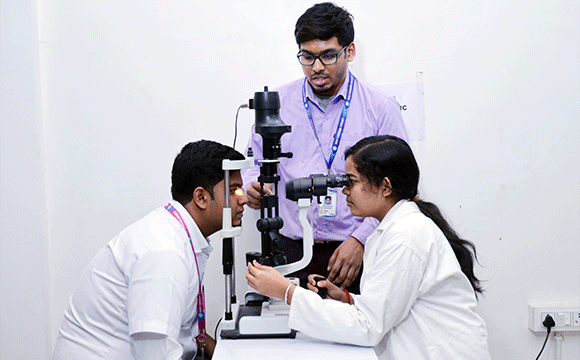
Hands-on training with the latest diagnostic instruments, imaging technologies, and computerized systems

Strong focus on research, case-based learning, and evidence-based optometric practice

Mentorship from highly experienced faculty members and clinical experts

Extensive clinical exposure, patient interaction, internships, and career guidance with placement support

Online Application Form

Course Eligibility

Bachelor of Optometry (B.Optom) or equivalent degree from a recognized university

Minimum 50% marks or above in the qualifying undergraduate examination.

Programme Highlights

Advanced Clinical Training & Specialization

Research-Oriented Learning & Skill Development

Industry Exposure & Professional Growth Opportunities

Guidance from Expert Clinicians and Academicians

Earn While You Learn
Global Internship & Placement
Expert Faculties

Career Opportunities

FREQUENTLY ASKED QUESTION

A Master of Optometry degree opens up advanced and specialized career opportunities in the field of eye and vision care. Graduates can work as senior clinical optometrists, contact lens specialists, low vision or binocular vision experts, and consultants in hospitals, specialty eye clinics, and tertiary care centers. They may also pursue careers in academics as lecturers or assistant professors, or engage in clinical and vision science research, including PhD programmes. In addition, opportunities exist in the optical and ophthalmic industry as clinical specialists, trainers, or product experts, as well as in public health, NGOs, and international eye-care organizations.

After completing a Master of Optometry, graduates can expect an average starting salary of ₹3 LPA to ₹5 LPA, depending on their specialization, clinical expertise, and place of employment. Those working as senior clinical optometrists, contact lens specialists, or consultants in reputed hospitals and eye care centers may earn higher packages. With experience, specialization, or independent clinical practice, income potential increases significantly. Opportunities in academics, research, industry, and international roles can further enhance long-term earning prospects.

To perform successfully at a professional and advanced level, Master of Optometry graduates must possess strong clinical decision-making and analytical skills to manage complex ocular conditions. Excellent communication and patient-counseling abilities are essential for effective interaction with patients and multidisciplinary healthcare teams. In addition, research aptitude, problem-solving skills, leadership qualities, and teamwork spirit are crucial, especially when working in hospitals, academic institutions, or collaborative clinical environments. Continuous learning and adaptability to new technologies further enhance professional growth.

Our recruiter

Board Of studies

© Copyright All Right Reserved , SVU Privacy Policy
phone whatsapp mail