
Centre For Faculty Development Programme
Mission
1. Professional Growth and Development:
- To facilitate continuous professional growth and development of faculty members.
- To provide opportunities for faculty to acquire new skills, knowledge, and pedagogical techniques.
2. Excellence in Teaching and Learning:
- To enhance the quality of teaching and learning methodologies within the institution.
- To foster an environment that promotes innovative and effective teaching practices.
3. Research and Scholarship:
- To encourage and support faculty engagement in meaningful research and scholarly activities.
- To contribute to the creation of a vibrant intellectual community within the institution.
4. Adaptation to Technological Advancements:
- To equip faculty with the necessary technological skills and tools to enhance the educational experience.
- To promote the integration of technology into teaching and research processes.
5. Student-Centered Approach:
- To focus on strategies that positively impact student success and engagement.
- To cultivate a student-centered learning environment through faculty development initiatives.
Vision
1. Leadership in Education:
- To position the institution as a leader in providing high-quality education through the development of its faculty.
2. Innovation in Teaching and Research:
- To foster a culture of innovation and creativity in teaching and research methodologies.
3. Global Recognition:
- To enhance the institution’s global recognition by producing well-rounded and highly skilled graduates.
4. Collaboration and Networking:
- To promote collaboration and networking among faculty members, both within the institution and with external academic communities.
5. Continuous Improvement:
- To establish a culture of continuous improvement, where faculty members are committed to lifelong learning and development.
6. Community Engagement:
- To encourage faculty involvement in community service, outreach programs, and initiatives that contribute to societal development.
7. Alignment with Institutional Goals:
- To align the Faculty Development Programme with the overall goals and strategic objectives of the institution.
Objectives
1. Enhancing Teaching Skills:
- To improve the pedagogical skills of faculty members, fostering innovative and effective teaching methods.
- To promote student-centered approaches and active learning strategies.
2. Promoting Research and Scholarly Activities:
- To encourage and support faculty engagement in research and scholarly activities.
- To provide resources and mentorship for faculty pursuing advanced degrees or conducting impactful research.
3. Keeping Abreast of Advancements in the Field:
- To ensure that faculty members stay current with the latest developments, trends, and advancements in their respective fields.
- To provide training on emerging technologies and methodologies relevant to teaching and research.
4. Developing Leadership and Administrative Skills:
- To equip faculty with leadership and administrative skills necessary for roles such as department chairs, program coordinators, or other administrative positions.
- To foster a culture of academic leadership within the institution.
5. Facilitating Interdisciplinary Collaboration:
- To encourage collaboration and interdisciplinary interactions among faculty members.
- To create opportunities for faculty to engage in cross-disciplinary projects and initiatives.
6. Integrating Technology in Teaching and Learning:
- To enhance the technological proficiency of faculty members.
- To promote the effective integration of technology in curriculum development, course delivery, and assessment.
7. Addressing Diversity and Inclusion:
- To promote inclusive teaching practices that accommodate diverse student populations.
- To raise awareness of cultural competence and sensitivity among faculty members.
8. Improving Assessment and Evaluation Techniques:
- To enhance faculty skills in designing effective assessments and evaluating student learning outcomes.
- To promote the use of data-driven approaches for continuous improvement.
9. Encouraging Professional Networking:
- To facilitate networking and collaboration among faculty members within the institution and with external academic communities.
- To provide opportunities for sharing best practices and experiences.
10. Supporting Work-Life Balance and Well-being:
- To promote faculty well-being and work-life balance through programs addressing stress management, time management, and self-care.
11. Aligning with Institutional Goals:
- To ensure that the Faculty Development Programme aligns with the overall goals and strategic priorities of the institution.
Report
-
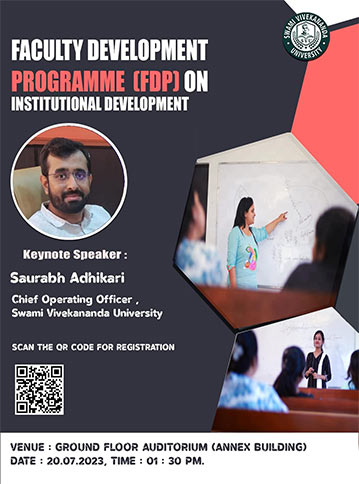
Institutional Development
Introduction:
This report provides an overview of the Faculty Development Program (FDP) conducted on institutional development. The FDP aimed to enhance the knowledge and skills of participants in various aspects of institutional development, including strategic planning, leadership, governance, and quality assurance.
Objectives:
To familiarize participants with the concept and importance of institutional development in higher education.
To provide participants with an understanding of strategic planning and its role in institutional growth and sustainability.
To enhance participants’ leadership and management skills for effective institutional governance.
To promote a culture of quality assurance and continuous improvement within the institution.
Methodology:
The FDP was conducted through a combination of lectures, interactive sessions, case studies, workshops, and group discussions. Experts in the field of institutional development and higher education management were invited to share their knowledge and experiences. Participants were encouraged to actively engage in discussions, share their institutional challenges, and seek solutions collaboratively.
Key Topics Covered:
Understanding institutional development: Participants were introduced to the concept of institutional development and its significance in the context of higher education. They learned about the key components of institutional development, including strategic planning, leadership, governance, and quality assurance.
Strategic planning: The FDP focused on the importance of strategic planning in institutional development. Participants learned about the process of developing a strategic plan, including conducting a SWOT analysis, setting goals and objectives, and implementing strategies for achieving them.
Leadership and governance: The program emphasized the role of effective leadership and governance in institutional development. Participants gained insights into leadership styles, decision-making processes, and the importance of fostering a collaborative and inclusive culture within the institution.
Quality assurance: The FDP addressed the significance of quality assurance in institutional development. Participants learned about quality assurance frameworks, accreditation processes, and the importance of continuous improvement in maintaining and enhancing institutional quality.
Change management: The program explored the challenges and strategies associated with managing change within an institution. Participants learned about change management models, communication strategies, and the role of leadership in facilitating successful organizational change.
Outcomes:
Enhanced knowledge and skills: Participants developed a deeper understanding of institutional development and acquired practical skills in strategic planning, leadership, governance, and quality assurance.
Improved institutional planning and management: The FDP equipped participants with the tools and techniques to develop and implement effective strategic plans, enhance leadership and governance practices, and establish quality assurance mechanisms within their institutions.
Collaboration and networking: The program provided a platform for participants to connect with experts and fellow educators, fostering potential collaborations and sharing of best practices in institutional development.
Institutional growth and sustainability: It is expected that the knowledge and skills gained through the FDP will contribute to the overall growth and sustainability of the participating institutions, leading to improved academic outcomes and institutional reputation.
Conclusion:
The FDP on institutional development successfully achieved its objectives of enhancing participants’ knowledge and skills in strategic planning, leadership, governance, and quality assurance. The program equipped participants with practical tools and strategies to drive institutional growth and sustainability. It is anticipated that the knowledge gained will positively impact the participating institutions, leading to improved academic outcomes and institutional excellence.
-
Time Management Skills for Teaching Fraternity
The report for this programme will be published shortly.
-
Time Management Skills for Teaching Fraternity
The report for this programme will be published shortly.
-
Time Management Skills for Teaching Fraternity
The report for this programme will be published shortly.
-
Indian Cultural Heritage
The report for this programme will be published shortly.
-
Research Paper Writing and Publication in Scopus/ WoS Journals
The report for this programme will be published shortly.
-
Research Paper Writing and Publication in Scopus/ WoS Journals
The report for this programme will be published shortly.