
B.Tech in Electronics & Communication Engineering
The programme blends classroom instruction, laboratory or field practice and continuous internal assessment. Students a…
Read More about B.Tech in Electronics & Communication EngineeringAnalog and digital electronics, embedded systems, VLSI and communication engineering.
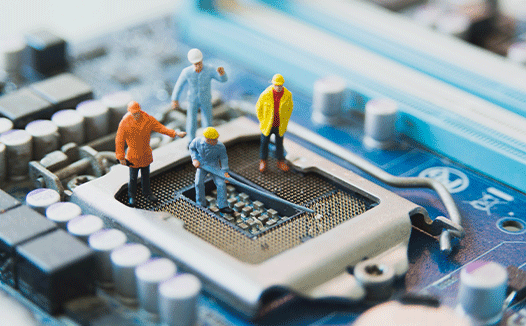
ECE focuses on understanding the behavior, design, and applications of electronic components and circuits. This includes semiconductor devices like diodes and transistors, integrated circuits, amplifiers, oscillators, and digital logic circuits. The field of ECE covers the study of various communication systems, both analog and digital and the design topology of antenna including free-space wave propagation. Various communication systems and networking protocols are incorporated here. ECE involves the analysis and manipulation of signals to extract information or enhance their quality. Signal processing techniques are used in various applications, including image processing, audio processing, speech recognition, and data compression. ECE deals with the design and fabrication of microelectronic devices and integrated circuits. It involves working with very small-scale components, often at the nanometer level, to create powerful and efficient electronic systems including designing complex integrated circuits with millions or billions of transistors on a single chip.
Part of the School of Engineering.
The programme blends classroom instruction, laboratory or field practice and continuous internal assessment. Students a…
Read More about B.Tech in Electronics & Communication EngineeringThe programme provides advanced knowledge in electronics and communication engineering through specialised coursework, …
Read More about M.Tech in Electronics & Communication EngineeringThe primary goal of the Department of Electronics & Communication is to advance knowledge and education in its field. The department serves various objectives, including:
Education: Providing high-quality education at undergraduate, postgraduate and doctoral level, equipping students with a solid foundation in both principles and practical skills.
Research: Advancing the state of knowledge through research, with faculty and students working on projects that contribute to the discipline.
Innovation: Encouraging innovation and entrepreneurship, and supporting ideas that address real-world problems.
Professional Development: Preparing students for their careers through internships, industry connections and structured training.
The commitments that shape how the Department of Electronics & Communication teaches and works.
Integrity: Honest conduct in study, assessment and research, upheld by a clear academic integrity policy.
Excellence: Continuous improvement of curriculum, laboratories and teaching, guided by student feedback each semester.
Collaboration: Open exchange between students, faculty, industry partners and other institutions.
Inclusivity: Support for every student regardless of background, with mentoring for those who need it.
What a student gets access to in the Department of Electronics & Communication:
Well-Equipped Laboratories: Practical work is mapped to the syllabus, with laboratories open beyond scheduled class hours.
Industry-Aligned Curriculum: The syllabus is reviewed with industry members on the Board of Studies.
Experienced Faculty: Doctorate and postgraduate faculty at a healthy student-to-teacher ratio.
Training & Placement: Aptitude and interview training from the pre-final year, run by the central training and placement cell.
Reasons students give for choosing the Department of Electronics & Communication here:
Hands-On From Year One: Laboratory and field work begins early rather than waiting for the final-year project.
Mentoring: Every student is attached to a faculty mentor who follows their progress across the programme.
Certifications: Value-added certification courses run alongside the degree.

Welcome to the Department of Electronics & Communication. Our work here is less about teaching a fixed set of tools than about building the foundation that lets a graduate pick up the next one on their own, because every discipline changes faster than a syllabus can be revised.
Our faculty combine teaching with active research, and our laboratories stay open to students who want to build something beyond the prescribed practicals. Alongside the syllabus we run projects, industry visits and certification courses, so a student leaves with a record of work as well as a transcript.
If you are considering this department, come and see the campus - talk to the students and the teachers, not just the prospectus.
Head of the Department
Department of Electronics & Communication